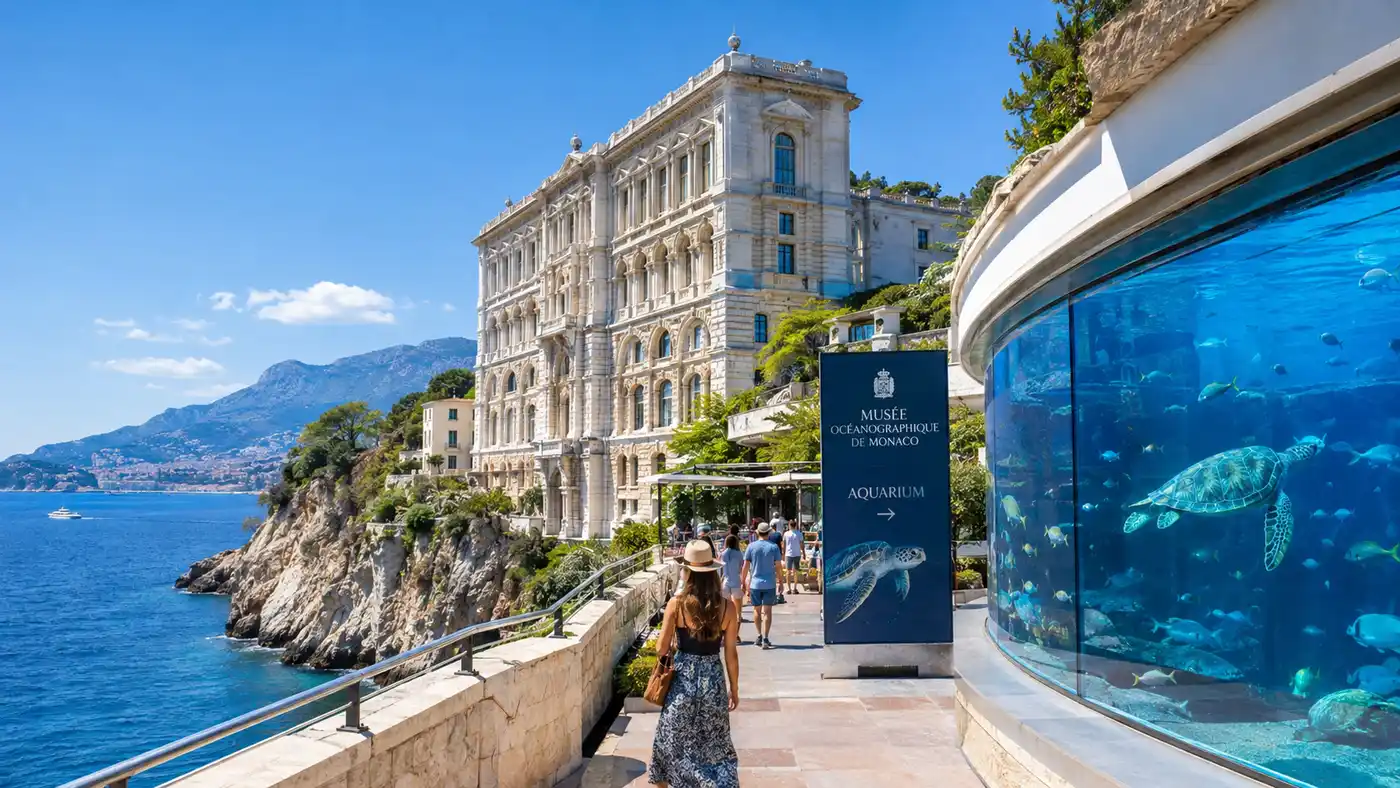
Monaco Aquarium Guide at the Oceanographic Museum
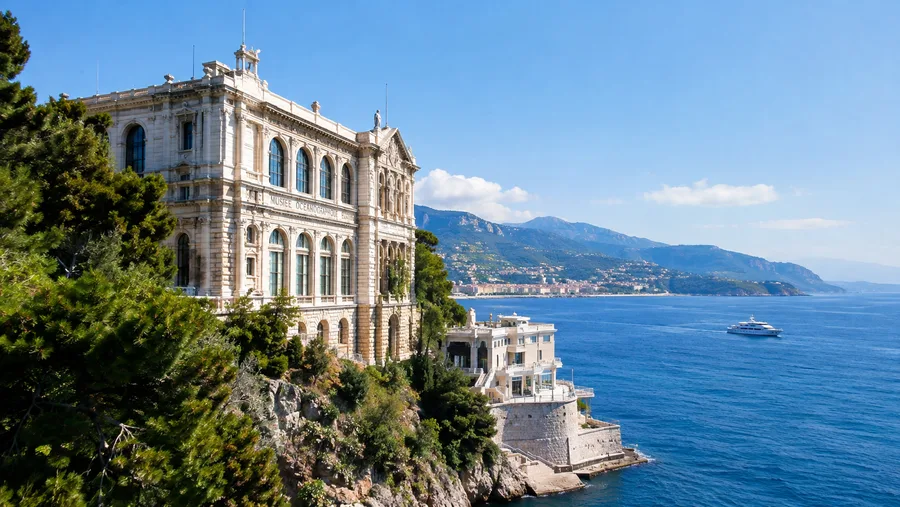
Perched on the sheer limestone cliff of Le Rocher, the building hangs almost eighty meters above the sea. Most people come up the winding alleys of Monaco-Ville to see the Prince's Palace or stare at the mega-yachts down in Port Hercule, but the real marvel is tucked into the vaulted basement of this neoclassical palace. The monaco aquarium is not just another municipal fish tank with blue neon backlights. It feels older, darker, and infinitely more atmospheric than modern mega-aquariums, like stepping into a subterranean Jules Verne laboratory carved straight into the rock face.
Down on level -1 and level -2, the air cools down instantly. You leave the Mediterranean sun behind and enter rooms illuminated only by glowing glass tanks filled with living coral, deep-sea oddities, and creatures collected from the local coastline. Whether you have two hours to spare on a French Riviera day trip or you want a quiet corner away from the Monte Carlo casino crowds, this guide walks you through every corner of the display tanks, conservation projects, and practical logistics.
Book your oceanographic museum of monaco experience:
What Makes the Aquarium in Monaco Unique
Seawater inside these tanks comes directly from the Mediterranean. A pumping station at the foot of the cliff pulls water from roughly fifty meters below sea level, filtering it lightly so natural nutrients stay intact. Because of this continuous flow, organisms thrive here that simply refuse to survive in artificial closed loops. Sponges, delicate gorgonian corals, and small invertebrates grow directly on the tank walls without being planted by staff.
Prince Albert I founded this place back in 1910. He spent decades sailing the world on research vessels, collecting specimens and measuring ocean depths, and he designed the oceanographic museum and aquarium to share those findings with anyone willing to climb the rock. You can still feel that pioneer spirit. The vaulted stone arches supporting the ceiling make the halls feel like a cathedral crypt, yet the water treatment technology hidden behind the stone walls remains thoroughly modern.
It is small compared to places like the Georgia Aquarium or the massive tanks in Valencia. You can walk the whole basement in an hour if you rush. Honestly, rushing is a mistake. The magic here lies in the small things: a well-camouflaged stonefish hiding against red rocks, tiny sea horses clinging to posidonia grass, or cuttlefish flashing iridescent colors when an aquarist walks past.
Navigating the Main Tanks and Galleries
The basement splits into three distinct viewing zones, each arranged with its own mood and lighting.
First comes the Mediterranean zone. It holds around a hundred species native to the waters right outside the building. You will see moray eels poking their jaws from rock crevices, dusty groupers hovering motionless, and schools of silver bream drifting in gentle artificial currents. The Mediterranean is often dismissed as empty compared to tropical seas, but this room proves how dense and strange local waters actually are.
Next is the tropical zone, which bursts with electric yellows, blues, and neon greens. In 1989, researchers here achieved something incredible: they managed to grow live tropical corals in captivity for the first time on European soil. Those original colonies are still growing. Thick branching staghorn corals and soft waving polyps fill a succession of tanks, accompanied by clownfish, boxfish, and lethal lionfish.
Note: Flash photography is strictly forbidden throughout the underground galleries because the sudden light blinds the deep-water species and disorients the sea turtles.
The centerpiece of the entire lower level is the Shark Lagoon. Built in 2000, this tank holds 450,000 liters of water behind a curved glass wall that measures thirty centimeters thick. It houses nurse sharks, blacktip reef sharks, a giant guitarfish, and a hawksbill sea turtle that likes to sleep wedged between the artificial reef rocks. Watching a ray glide directly over your head against the dim blue glow is genuinely hypnotic.
| Gallery Zone | Key Species | Average Time | Best Time to View |
|---|---|---|---|
| Mediterranean Zone | Moray eels, red coral, spiny lobsters | 25 mins | Midday (very quiet) |
| Tropical Coral Seas | Living coral colonies, clownfish, stonefish | 30 mins | Early morning |
| Shark Lagoon | Nurse sharks, blacktip sharks, giant rays | 35 mins | During feeding sessions |
| Turtle Odyssey | Loggerhead and green sea turtles | 20 mins | Late afternoon |
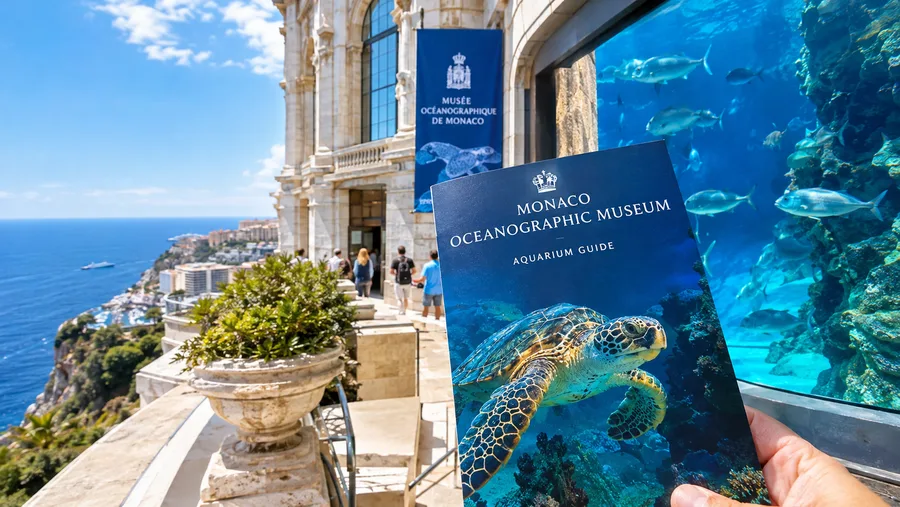
Feeding Times and Interactive Spaces
Watching the animals eat gives you a whole new appreciation for how they behave in the wild. Tank feedings happen throughout the week on a rotating schedule, though the aquarists do not feed every animal every day to mimic natural rhythms. When the diver enters the Shark Lagoon with a steel basket of mackerel and squid, the rays turn into frantic kites, fluttering against the glass to get attention.
If you want to catch one of these presentations, here is what you should keep in mind:
- Arrive early for lagoon feedings: visitors pack the benches around the curved glass fifteen minutes before staff even open the access hatch.
- Check the daily chalkboard: times change based on veterinary schedules and seasonal water temperatures, so check the entry board at the basement stairs.
- Look for the tactile pool: children can touch small dogfish, starfish, and sea urchins under the guidance of a staff educator, though this requires a separate small booking token.
- Watch the coral nursery: staff frequently work on the micro-fragmentation tables in full view of the public during mid-morning hours.
The touch tank is tucked near the back corner. Kids love it, obviously, but adults tend to linger just as long. Slipping your fingers into cool seawater to feel the rough, sandpaper skin of a harmless juvenile catshark is not something you get to do on a typical city break.
Book your oceanographic museum of monaco experience:
Conservation and the Turtle Rescue Center
The monaco oceanographic museum and aquarium is not just a public spectacle. It serves as an active research post and rehabilitation hospital. In 2019, they expanded their work by opening the Monaco Sea Turtle Care Center, situated partly on the outdoor terrace overlooking the sea.
Injured turtles found along the coast between Cannes and the Italian border are brought here by local boaters, coastal police, or fishermen. Most suffer from plastic ingestion, hook injuries, or cracked shells caused by speedboat propellers. The clinic features dedicated medical recovery pools where veterinarians nurse the animals back to health before tagging and releasing them into the wild.
Pro tip: Step outside to the lower seaward terrace to see the rehabilitation basin; you can observe recovering loggerheads basking in open sunlight with genuine sea breezes blowing off the water.
Beyond turtles, the facility leads ongoing efforts to save Mediterranean red coral, which has been severely overharvested for jewelry over the centuries. You can read about the pioneering oceanographers who laid the foundation for these programs in our guide to the directors of the institute, including Jacques Cousteau, who ran operations here for over three decades.
Cousteau pushed hard for marine reserves back when people thought the sea was an endless dumping ground. His old research gear, dive submersibles, and brass instruments are scattered throughout the upper floors of the building. The aquarium below is the living extension of those early warnings.
Practical Tips for Visiting the Monaco Aquarium
Getting up to Le Rocher takes a little effort. You can hike the Rampe Major path from the Place d'Armes market, which involves about ten minutes of cobblestone stairs climbing beneath pine trees. It gives fantastic views over the harbor. If you have strollers or simply do not feel like climbing in the summer heat, take bus line 1 or line 2 from the train station; they drop you right beside the museum entrance.
The building gets intensely crowded between 11:00 AM and 2:30 PM, especially from June through September when cruise tenders unload down in the bay. The basement hallways are relatively narrow, and because lighting is kept low for the fish, tight crowds can make the experience feel cramped.
- Go first thing in the morning: doors open at 10:00 AM, and you will have the Shark Lagoon almost entirely to yourself for the first forty minutes.
- Buy combined passes online: buying tickets in advance lets you skip the ticket queue at the outdoor portico, which can stretch past the garden gates in July.
- Check current pricing: admission covers both the upstairs museum galleries and the basement aquarium, as detailed in our guide to ticket options.
- Bring a light layer: the basement tanks are chilled to match deep-water temperatures, which feels brisk after walking up the sun-drenched hill.
- Avoid peak lunch hours: the small on-site rooftop restaurant fills up instantly, so eat down in Monaco-Ville before heading inside.
Allow about two to two and a half hours for the complete building. Dedicate forty-five minutes to the aquarium tanks, thirty minutes to the turtle clinic and outdoor terraces, and the rest to the massive whale skeletons and cabinet of curiosities upstairs.
Frequently Asked Questions about monaco aquarium
Is the aquarium suitable for small children and strollers?
Yes. The museum has elevators connecting the upper floors to the basement aquarium levels, though the historic elevator can be slow during rush hours. Strollers navigate the tank hallways easily, but baby carriers offer better mobility if the rooms get crowded.
How long do you need to visit the aquarium in Monaco?
Most visitors spend between 45 minutes and an hour exploring just the basement aquarium tanks. To see the entire facility, including the rooftop sea turtle center and the upstairs historical exhibits, budget at least two full hours.
Can you visit just the aquarium without paying for the museum?
No. Admission is sold as a single general ticket that grants access to the entire building, including the basement aquarium, the historic laboratory displays, temporary art exhibitions, and the panoramic rooftop terrace.
Quick Reference
- Location: Monaco-Ville cliffside, Le Rocher
- Opening time: 10:00 AM daily year-round
- Main tank volume: 450,000 liters (Shark Lagoon)
- Water source: Direct pump from Mediterranean at 50m depth
- Total species: Over 350 marine species on display
Book your oceanographic museum of monaco experience:
Before You Go
The aquarium in Monaco offers a completely different rhythm from the glitz and sports cars on the opposite side of the harbor. Down in the vaulted stone basement, the hum of filtration pumps and the blue water make you forget that millionaires are sipping champagne three hundred feet above you on the palace terraces. Buy your ticket early, head straight down to the shark tank before the tour groups arrive, and take your time watching the reef corals sway in clean Mediterranean currents.
Read more about oceanographic museum of monaco.